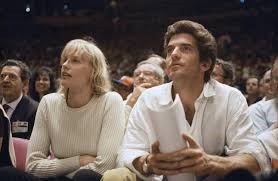
In Love Story: John F. Kennedy Jr. & Carolyn Bessette, the new FX/Hulu drama from creator Ryan Murphy, audiences are invited not just into a tragic love story but into a reexamination of what it means to be a cool girl through the enigmatic presence of Carolyn Bessette-Kennedy.
The series opens with the well-known final moments of Bessette-Kennedy and John F. Kennedy Jr., whose small plane crashed off Martha’s Vineyard in 1999, killing both and symbolizing the inevitable heartbreak at the center of their romance. But rather than merely chronicling the end, the show’s early episodes focus on the beginning: the slow-burn flirtation between a high-profile playboy and a fashion-world outsider making her way in ’90s New York.
What sets this retelling apart is its portrayal of Bessette-Kennedy not as a love interest who merely capitulates to patriarchal desire, but as a woman whose authentic self-possession unsettles and ultimately reshapes the dynamic between her and Kennedy. Whereas John’s wealth and celebrity might have traditionally placed him in a position of power, the series shows Carolyn remaining emotionally autonomous, casually withholding her phone number and meeting him on her own terms.
This characterization revisits the “cool girl” archetype that has long circulated in pop culture typically defined by detachment, emotional reserve, and an almost performative indifference toward romantic pursuit. But Love Story reframes it: the coolness here isn’t an act or a manipulation, but a reflection of Bessette-Kennedy’s inner confidence and self-worth. She doesn’t chase; she chooses. And in doing so, she becomes the one Kennedy must work for.
While the trope of the cool girl has historically been criticized for promoting emotional suppression as a means to secure interest, Love Story stakes a different claim. Carolyn’s reserve isn’t about winning a man; it’s about knowing her value in a world that often rewards acquiescence. Her coolness isn’t a strategy, it’s her nature.
This depiction resonates on a deeper cultural level. Instead of rewarding emotional availability or vulnerability alone, the series suggests that confidence, self-possession, and intentionality are powerful forces in relationships. Bessette-Kennedy isn’t playing a game; she’s asserting herself in one where men historically held the advantage.
In Love Story, Carolyn stands not just as a love interest but as a figure of personal strength unapologetic, self-assured, and rich human. Her portrayal reframes the cool girl not as a caricature of emotional detachment but as a woman who knows what she wants and why she deserves to be chosen.
The result is a narrative that goes beyond mere nostalgia for a fascinating couple’s romance. It becomes a meditation on agency in love, challenging traditional power dynamics and offering a more nuanced and empowering interpretation of what it truly means to be “cool” in both romance and life.