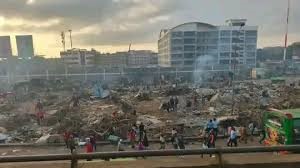
More than 1,000 roadside traders operating at Githurai Market along the busy Thika Superhighway are reeling from heavy economic losses after their stalls and makeshift structures were demolished early on Thursday morning. The demolition, carried out by the Kenya National Highways Authority (KeNHA), has left many traders without their primary source of income and sparked protests in the area.
The demolitions followed a seven-day eviction notice issued by KeNHA on February 9, 2026, which directed traders along the Thika Road reserves at Roysambu and Githurai to remove their goods and structures to make way for the construction of designated bus bays and a modern bus park intended to improve public transport safety and reduce traffic congestion along one of Kenya’s busiest roads.
Despite the notice, many traders said they were not adequately prepared for the sudden enforcement and accused authorities of failing to provide alternative trading spaces before demolishing their stalls. They argue that the clearance has crippled their livelihoods, pushing many families deeper into economic hardship.
Traders described the demolished structures including kiosks, wooden sheds and metal stalls as their only means of survival. Some were forced to hurriedly remove goods as excavators and bulldozers flattened businesses along the roadside. Others stood amid twisted iron sheets and splintered timber trying to recover what remained after years of operating in the area.
The sudden action sparked angry protests, with traders and residents blocking sections of the Thika Superhighway by lighting bonfires and burning tyres, causing traffic disruptions as motorists were diverted to alternative routes. Police were deployed in large numbers to control the situation and prevent further escalation.
The demolition has drawn sharp criticism from political figures. Former Deputy President Rigathi Gachagua condemned the government’s actions as “inhumane” and “senseless,” accusing authorities of treating ordinary citizens like criminals amid a struggling economy. He questioned the need for a heavy police presence at night and argued that the approach lacked compassion and adequate planning.
Local traders also blame the government for empty promises and say the enforcement contradicts assurances given previously to protect informal businesses across the country. Many are sceptical about the claimed development goals and worry that the cleared land may be used for private commercial projects with little benefit to the small-scale traders who once depended on that space.
As the dust settles on the demolished stalls, traders in Githurai are left grappling with the immediate economic fallout and uncertainty about the future. Calls for proper compensation, consultation, and relocation plans have grown louder, with residents urging authorities to adopt more humane solutions in handling such operations in the future.