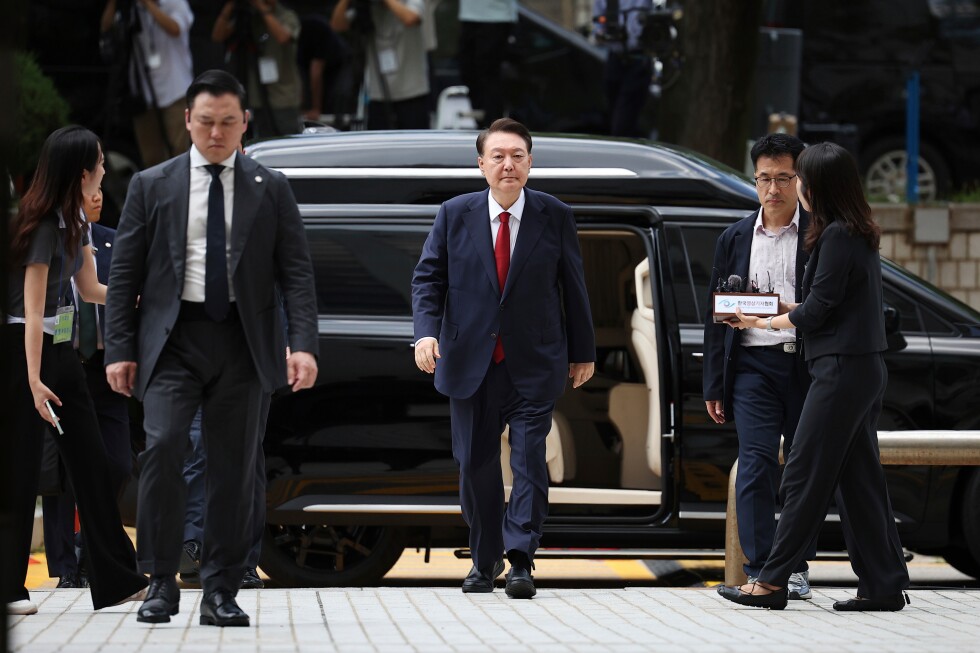
SEOUL In a landmark ruling that caps one of the most tumultuous political crises in recent South Korean history, a Seoul court on Thursday convicted former President Yoon Suk Yeol of leading an insurrection and sentenced him to life in prison for his brief but dramatic attempt to impose martial law in December 2024.
The Seoul Central District Court found that Yoon’s actions declaring martial law, mobilizing military and police forces, and attempting to surround the National Assembly in an effort to arrest lawmakers amounted to rebellion and a direct assault on the constitutional order. Prosecutors had sought the death penalty, but the court instead issued life imprisonment, a punishment reserved for the most serious crimes.
The court determined that Yoon intended to seize control of the legislature, arrest political opponents and establish unchecked control “for a considerable time,” steps that went far beyond any legitimate constitutional powers.
The crisis began on Dec. 3, 2024, when Yoon, facing persistent opposition from a liberal-led National Assembly that blocked his agenda, declared martial law and dispatched troops to surround the legislature. Lawmakers quickly broke through a military blockade, and the martial law was lifted after roughly six hours.
This dramatic confrontation between the executive and the legislature recalled memories of South Korea’s past periods of authoritarian rule and ignited widespread public debate about the country’s democratic institutions.
Following the failed martial law attempt, the National Assembly impeached Yoon on Dec. 14, 2024, and in April 2025, the Constitutional Court upheld that impeachment unanimously, formally removing him from office. Yoon was arrested in July 2025 and has been detained while facing multiple criminal cases, with the rebellion charge being the most serious.
The life sentence marks the harshest punishment ever imposed on a democratically elected South Korean leader. Although former military dictator Chun Doo-hwan received a death sentence in the 1990s for a coup and a brutal 1980 crackdown, it was later commuted to life in prison under a broader amnesty; Chun was released in 1997.
Several of Yoon’s senior aides and Cabinet members were also convicted in connection with enforcing martial law. Former Defense Minister Kim Yong-hyun received a 30-year sentence for his central role in planning and executing the decree. Other officials, including former Prime Minister Han Duck-soo, received lengthy prison terms for trying to justify or implement the martial law orders.
Public reaction to the verdict was sharply divided, with both supporters and critics rallying outside the courthouse. While some saw the sentence as a necessary defense of democracy and the rule of law, Yoon’s allies have denounced the trial as politically motivated and pledged to appeal.
The case has profound implications for South Korea’s democratic norms, testing the limits of executive power and how far a leader can go against institutional checks and balances. During his presidency, Yoon a former prosecutor enjoyed early popularity but increasingly clashed with the opposition-led legislature, culminating in the ill-fated martial law gambit that ultimately ended his political career.
As Yoon and his co-defendants prepare appeals, the nation continues to grapple with the implications of a sitting president’s attempt to override parliamentary authority and the legal consequences of that attempt on the very fabric of Korean democracy